Switzerland’s first SPARC Compact CL system
Friday, 19.06.2026
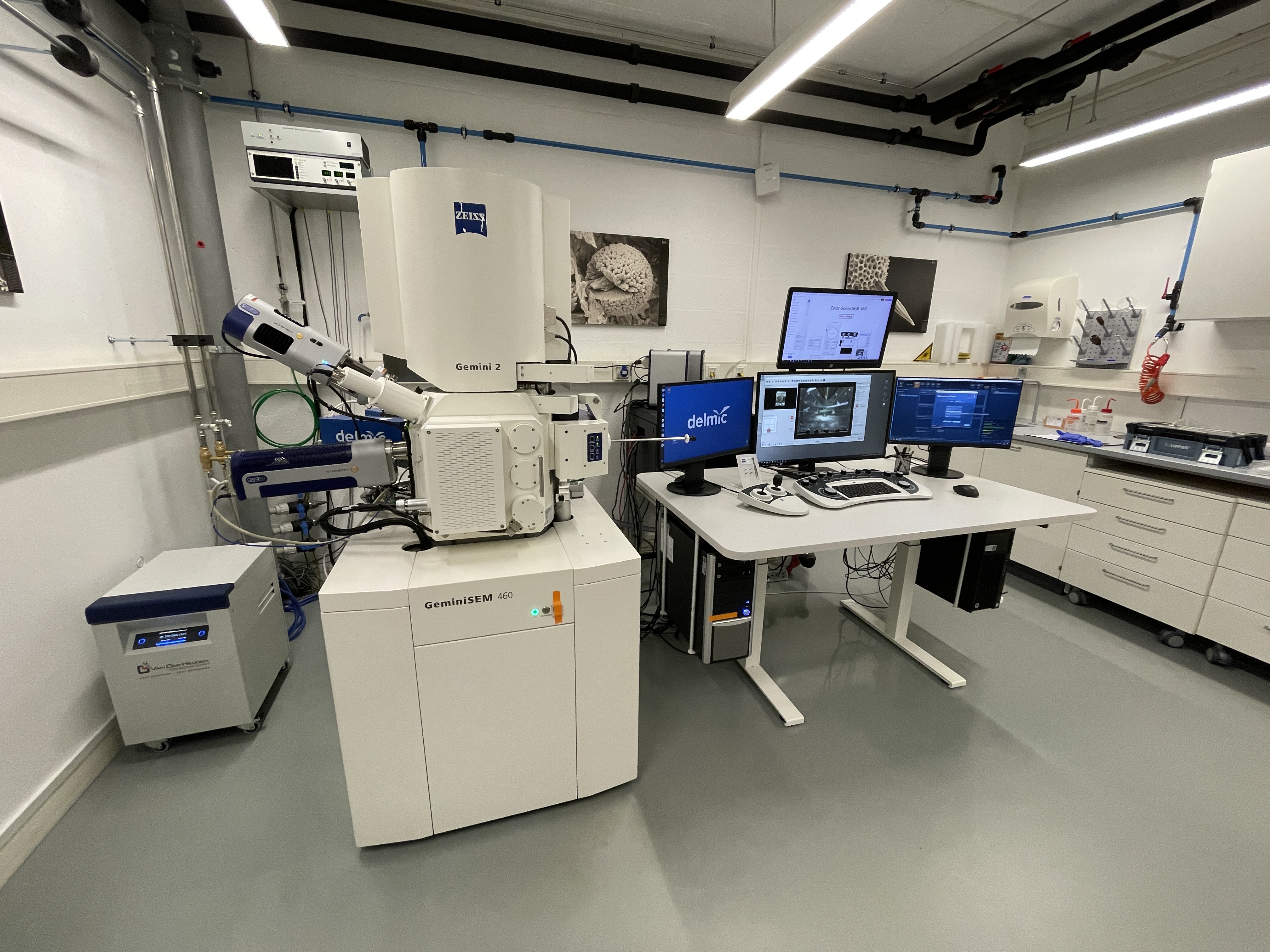
Switzerland’s first SPARC Compact CL system – now in use at the University of Lausanne.
The Faculty of Earth and Environmental Sciences (FGSE) is unique in Switzerland: it is dedicated to researching natural and anthropogenic changes to our planet, particularly in Alpine regions and urban centres. In doing so, it brings together various geoscience disciplines to understand the processes that shape our environment and landscapes.
With the recently installed SPARC Compact cathodoluminescence (CL) system, integrated into a ZEISS Gemini scanning electron microscope, researchers at the Institute of Earth Sciences in particular now have access to new analytical capabilities. Minerals store information about their origin and development in their chemical composition and crystalline structure. CL analysis makes these properties visible and allows valuable conclusions to be drawn about the formation history of rocks. The data obtained can also make an important contribution to the dating of minerals.
The first BSE and CL images of quartz, zircon and calcite show how this looks in practice:
- Quartz
CL: 20 kV · 1 nA · 140 ms dwell time
→ Internal growth pattern of the quartz grain


- Zircon
CL: 5 kV · 500 pA · 140 ms dwell time
→ Twin zircon crystal


- Calcite
CL: 8 kV · 2 nA · 400 ms dwell time
Bandpass filter: 400 nm · 50 nm bandwidth
→ Cell-like microstructures of Microcodium (root cortex cells)


All the images and measurement data shown were provided to us by Dr Goran Andjić from the University of Lausanne.
The images were taken at the Faculty of Geosciences and Environment (FGSE) at the University of Lausanne. The system is integrated into a ZEISS Gemini scanning electron microscope fitted with an ULTIM Max EDS and Symmetry EBSD detector from Oxford Instruments. By combining the SPARC Compact CL system with the ZEISS Gemini SEM, this information can be captured at high spatial resolution and directly linked to the electron microscope images. This opens up new possibilities for investigating the composition and formation of geological materials in even greater detail.
We are delighted to have realised Switzerland’s first SPARC Compact CL installation with this project.
Would you like to find out more about the possibilities offered by cathodoluminescence, or are you planning a similar project?
Please feel free to contact us – we’ll be happy to advise you on the right solutions and options for your application.
info@gloorinstruments.ch I 044 940 99 55